Navigating 2025 FAFSA Changes: 7 Key Updates for College Aid Applicants

The 2025 FAFSA introduces major reforms, including a new Student Aid Index (SAI) replacing the EFC, expanded Pell Grant eligibility, and a streamlined application process, fundamentally altering how federal student aid is determined and awarded.
Preparing for college often involves navigating the complex world of financial aid, and for the 2025-2026 academic year, the Free Application for Federal Student Aid (FAFSA) is undergoing its most significant overhaul in decades. Understanding these 2025 FAFSA changes is crucial for prospective students and their families to maximize their eligibility for federal grants, scholarships, and loans.
Understanding the FAFSA Simplification Act
The FAFSA Simplification Act represents a monumental shift in how federal student aid is calculated and distributed. This legislative effort aims to make the application process easier, expand eligibility for federal student aid, and provide a more accurate assessment of a family’s ability to pay for college.
For years, the FAFSA has been a cornerstone of college financing, but its complexity often deterred applicants. The 2025 changes are designed to streamline this experience, reducing the number of questions and integrating data directly from IRS tax returns. This reform is expected to benefit millions of students by making college more accessible and affordable.
Key Objectives of the Simplification Act
- Increased Access: Broaden the reach of federal aid to more students, especially those from low-income backgrounds.
- Simplified Process: Reduce the burden on applicants by cutting down on repetitive questions and utilizing direct data exchange.
- Enhanced Equity: Implement a more equitable formula for determining financial need, considering a wider range of family circumstances.
- Clearer Communication: Improve understanding of aid eligibility and award notifications for families.
This foundational shift underscores the federal government’s commitment to higher education access. By addressing long-standing issues with the FAFSA, the Simplification Act seeks to open doors for a new generation of college students, ensuring that financial barriers are less of an impediment to academic aspirations. Understanding these overarching goals helps contextualize the specific changes that will impact applicants.
The New Student Aid Index (SAI) Replaces EFC
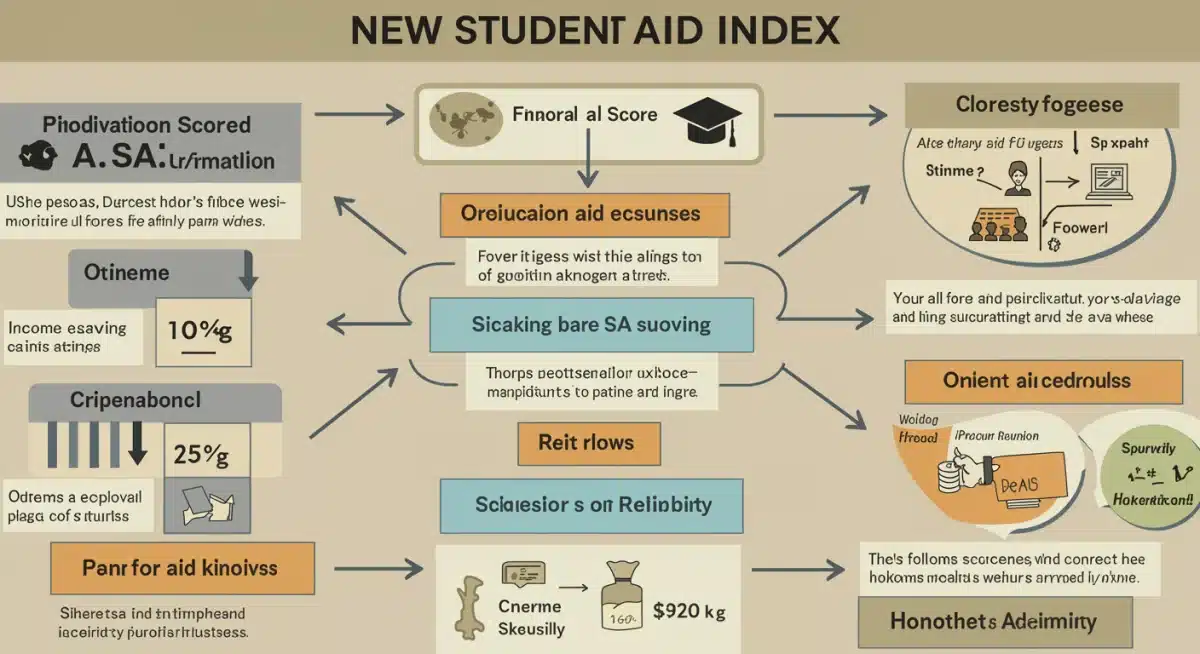
One of the most significant changes coming with the 2025 FAFSA is the replacement of the Expected Family Contribution (EFC) with the Student Aid Index (SAI). The EFC was often a source of confusion, as it wasn’t the amount a family was expected to pay, but rather an index used to determine aid eligibility. The SAI aims to be a clearer, more transparent metric.
The SAI is a number that colleges use to determine how much federal student aid a student is eligible to receive. Unlike the EFC, the SAI can be a negative number, extending eligibility for Pell Grants and other forms of aid to students with the highest financial need. This change reflects a more nuanced approach to assessing a family’s financial capacity.
How the SAI is Calculated
The calculation for the SAI introduces several modifications, aiming for greater accuracy and fairness:
- Income Assessment: The new formula places more emphasis on adjusted gross income (AGI) and less on assets for many families.
- Family Size: The number of family members in college will no longer be a direct factor in the SAI calculation, though family size itself remains relevant.
- Child Support: Child support received will now count as an asset, not income, which can positively impact aid eligibility for some families.
- Small Business/Farm Exclusion: For certain families, the value of small businesses and family farms will no longer be included in asset calculations.
The transition from EFC to SAI is more than just a name change; it’s a fundamental restructuring of how financial need is assessed. This new index is designed to be more intuitive and responsive to the economic realities faced by diverse families. Students and parents should familiarize themselves with these calculation methods to better anticipate their aid eligibility.
Expanded Pell Grant Eligibility
The Pell Grant program, a cornerstone of federal financial aid, is set to undergo significant expansion under the 2025 FAFSA changes. This expansion is designed to make college more affordable for low-income students, potentially providing grants to a larger number of applicants and increasing the award amounts for many.
Historically, Pell Grant eligibility was tied directly to the EFC. With the introduction of the SAI, eligibility criteria are being revised. The new framework aims to automatically qualify more students from low-income backgrounds for the maximum Pell Grant award, thereby reducing their reliance on loans and out-of-pocket expenses.
New Pell Grant Qualification Criteria
- Maximum Pell Grant: Students whose SAI is zero or negative will automatically qualify for the maximum Pell Grant.
- Income Thresholds: Specific income thresholds, tied to the federal poverty level, will also play a role in determining eligibility for the maximum award, especially for single-parent households.
- Inflation Adjustments: The Pell Grant maximum award will be adjusted annually for inflation, ensuring its purchasing power over time.
This expansion is a critical component of the FAFSA Simplification Act, directly addressing college affordability. Many students who previously received partial Pell Grants or were just outside the eligibility range may find themselves qualifying for substantial aid. It’s a game-changer for those who need financial assistance the most.
Simplified FAFSA Application Process
One of the primary goals of the FAFSA Simplification Act is to make the application process significantly easier and less time-consuming. The 2025 FAFSA will feature fewer questions, a more intuitive interface, and crucial integration with IRS data, all designed to reduce applicant burden and increase completion rates.
The previous FAFSA could be daunting, with over 100 questions that often required families to dig through various financial documents. The new version aims to cut this down dramatically, making it a more user-friendly experience that encourages more students to apply for aid.
Key Improvements to the Application
- Fewer Questions: The number of questions on the FAFSA will be significantly reduced, from over 100 to approximately 36.
- Direct Data Exchange: Applicants will be required to consent to direct data exchange with the IRS, allowing financial information to be securely transferred without manual entry.
- Streamlined Interface: The online FAFSA portal will be redesigned for a more modern, mobile-friendly experience.
- Contributor Model: The new FAFSA introduces the concept of ‘contributors,’ which includes the student, their spouse (if applicable), and one or both parents (if dependent), all of whom must provide consent for data retrieval.
The simplified application process is a welcome change for many. By reducing the number of questions and automating data transfer, the FAFSA will be less intimidating and more accessible. This streamlining is expected to alleviate stress for applicants and potentially lead to more students successfully applying for the financial aid they need.
Changes to Family Business and Farm Assets
Under the previous FAFSA, the net worth of small family businesses and family farms was often counted as an asset, which could significantly diminish a student’s eligibility for federal financial aid. This frequently posed a challenge for families whose wealth was tied up in these enterprises, making it appear as if they had more liquid assets than they truly did.
The 2025 FAFSA changes address this issue directly. Recognizing the unique financial structure of these assets, the new legislation provides an important exclusion, aiming to prevent these families from being unfairly penalized when applying for college aid.
Impact of the Exclusion
The new rules for family businesses and farms are significant:
- Asset Exclusion: The net worth of small businesses and family farms that meet specific criteria will no longer be included in the asset calculation for the Student Aid Index (SAI).
- Definition of Small Business/Farm: Generally, this applies to businesses with fewer than 100 full-time employees and farms where the family materially participates in operation.
- Fairer Assessment: This change ensures that families whose primary income and assets are derived from these ventures receive a more equitable assessment of their financial need.
This specific adjustment is a relief for many entrepreneurial and agricultural families. By excluding these assets, the FAFSA will offer a more accurate picture of their disposable income and available resources for college. This adjustment ensures that students from these backgrounds are not disadvantaged in the pursuit of higher education.
Impact on Divorced or Separated Parents
The 2025 FAFSA also introduces significant changes for students whose parents are divorced or separated. Previously, the FAFSA required financial information from the parent with whom the student lived the most during the past 12 months. This often led to scenarios where the custodial parent had lower income, thus increasing aid eligibility, even if the non-custodial parent had substantial resources.
The new FAFSA aims to simplify this by focusing on the parent who provides the most financial support, regardless of where the student lives. This change is intended to provide a more consistent and equitable approach to assessing parental contribution.
New Guidelines for Parental Information
- Primary Financial Supporter: The FAFSA will now require financial information from the parent who provides the most financial support to the student, not necessarily the parent with whom the student resides.
- Consistency: This change provides a more standardized rule, reducing ambiguity in complex family situations.
- Income-Driven: The focus shifts to the parent with the higher income contributing financially to the student, which may impact aid eligibility for some.
For students with divorced or separated parents, this change necessitates careful attention to which parent’s financial information is reported. It’s important for families to understand this new guideline to ensure accurate and timely submission of the FAFSA, as it could directly influence the student’s aid package.
The Role of Direct Data Exchange with IRS
A cornerstone of the 2025 FAFSA’s simplification efforts is the mandatory use of the Direct Data Exchange (DDX) with the IRS. This feature is designed to automate the transfer of federal tax information directly into the FAFSA application, significantly reducing the potential for errors and the time applicants spend gathering documents.
Prior to these changes, applicants often had to manually input tax information or use the IRS Data Retrieval Tool, which was optional and sometimes cumbersome. The DDX makes this process seamless, requiring only applicant consent for the secure transfer of data, ensuring accuracy and efficiency.
Benefits of Direct Data Exchange
- Reduced Errors: Automated transfer minimizes transcription errors that can delay aid processing.
- Increased Security: Data is transferred securely, reducing the risk of identity theft or fraud associated with manual handling of sensitive information.
- Faster Processing: The streamlined process allows for quicker submission and potentially faster aid award notifications.
- Mandatory Consent: All contributors to the FAFSA (student, spouse, parents) must provide consent for their tax data to be shared, even if they didn’t file taxes. Without this consent, the FAFSA cannot be processed.
The mandatory Direct Data Exchange represents a significant leap forward in simplifying the FAFSA. It not only makes the application process more efficient but also enhances data accuracy, which is vital for fair and timely aid determinations. Applicants should be prepared to provide consent for this data transfer to ensure their FAFSA is processed correctly.
What Applicants Need to Do Now
With the 2025 FAFSA changes on the horizon, proactive preparation is key for prospective college students and their families. Understanding these updates and taking necessary steps now can help ensure a smooth application process and maximize financial aid opportunities.
While the new FAFSA promises simplification, it still requires careful attention to detail and timely submission. Being informed about the new terminology, eligibility criteria, and application requirements will put applicants in the best position to secure the funding they need for higher education.
Essential Steps for Future Applicants
- Stay Informed: Regularly check official Department of Education and college financial aid websites for the latest updates and guidance.
- Gather Documents: Although the FAFSA is simplified, you’ll still need basic personal and financial information, including Social Security numbers, tax returns, and records of untaxed income.
- Create an FSA ID: All contributors (student, spouse, parents) will need an FSA ID to sign the FAFSA electronically and consent to IRS data retrieval.
- Understand the SAI: Familiarize yourself with how the Student Aid Index is calculated and how it differs from the EFC to better estimate your aid eligibility.
- Meet Deadlines: Pay close attention to federal, state, and college-specific FAFSA deadlines, as missing them can mean missing out on aid.
Navigating the upcoming FAFSA changes requires diligence and preparation. By understanding the new rules, gathering necessary information, and adhering to deadlines, applicants can confidently apply for federal student aid. These proactive steps are crucial for unlocking educational opportunities and managing college costs effectively.
| Key Update | Brief Description |
|---|---|
| SAI Replaces EFC | The Expected Family Contribution (EFC) is replaced by the Student Aid Index (SAI), a new metric that can be negative, broadening aid eligibility. |
| Expanded Pell Grant | More students, especially those with high financial need, will qualify for Pell Grants, with increased award amounts. |
| Simplified Application | The number of FAFSA questions is significantly reduced, and the process is more streamlined with direct IRS data exchange. |
| Mandatory IRS Data | All contributors must consent to direct data exchange with the IRS for financial information, ensuring accuracy and efficiency. |
Frequently Asked Questions About 2025 FAFSA Changes
The most significant change is the replacement of the Expected Family Contribution (EFC) with the Student Aid Index (SAI). The SAI provides a more accurate measure of a student’s financial need and can even be a negative number, potentially increasing aid for low-income families.
The 2025 FAFSA simplifies and expands Pell Grant eligibility. More students, particularly those with significant financial need, will qualify for Pell Grants, and some will automatically receive the maximum award based on income thresholds relative to the poverty line.
Yes, the application process is considerably streamlined. The number of questions has been reduced from over 100 to about 36. Additionally, mandatory direct data exchange with the IRS automates the transfer of financial information, simplifying the process for applicants.
A ‘contributor’ is anyone required to provide information on the FAFSA, including the student, their spouse (if applicable), and one or both parents (if dependent). All contributors must provide consent for their tax information to be retrieved from the IRS for the application to be processed.
No, under the 2025 FAFSA changes, the net worth of small businesses and family farms that meet specific criteria (e.g., fewer than 100 employees) will no longer be included in the asset calculation for the Student Aid Index (SAI), providing a fairer assessment.
Conclusion
The 2025 FAFSA changes represent a pivotal moment for federal student aid, promising a more accessible, equitable, and streamlined path to higher education for millions of American students. From the introduction of the Student Aid Index (SAI) to expanded Pell Grant eligibility and a simplified application process, these reforms are designed to alleviate financial barriers and foster greater educational attainment. While the transition may require some adjustment, understanding these key updates and preparing proactively will empower applicants to navigate the new system effectively and secure the financial support they need to achieve their academic dreams.