Community College vs. 4-Year University: A 2026 Cost-Benefit Analysis for US Students
Anúncios
Community College vs. 4-Year University: A 2026 Cost-Benefit Analysis for US Students
The journey into higher education is a significant milestone for many US students and their families. As we look towards 2026, the landscape of post-secondary education continues to evolve, presenting both exciting opportunities and complex decisions. One of the most fundamental choices prospective students face is whether to begin their academic career at a community college or directly enroll in a 4-year university. This decision is rarely simple, as it involves weighing a multitude of factors, from financial implications to academic experiences and long-term career prospects. Understanding the nuances of this choice requires a thorough college cost analysis, considering not just the sticker price but the overall value and return on investment.
For decades, the traditional path of immediately attending a 4-year university has been seen as the gold standard. However, community colleges have steadily grown in prominence, offering a viable, often more affordable, and flexible alternative. In 2026, with rising tuition costs, a competitive job market, and diverse learning needs, the debate between these two educational pathways is more relevant than ever. This comprehensive guide aims to provide a detailed college cost analysis, exploring the benefits and drawbacks of both community colleges and 4-year universities, specifically tailored for US students navigating their educational futures.
We will delve into the financial aspects, examining tuition fees, living expenses, financial aid opportunities, and potential debt accumulation. Beyond the numbers, we will also explore academic environments, transfer opportunities, career outcomes, and the overall student experience. By the end of this analysis, you will have a clearer understanding of which path might best align with your personal goals, financial situation, and academic aspirations. Let’s embark on this crucial exploration to help you make an informed decision for your future.
Anúncios
The Financial Landscape: A Deep Dive into College Costs in 2026
When discussing higher education, the conversation inevitably turns to cost. For many families, this is the primary driver behind their educational choices. In 2026, the financial disparities between community colleges and 4-year universities remain significant, making a thorough college cost analysis indispensable.
Tuition and Fees: The Most Obvious Difference
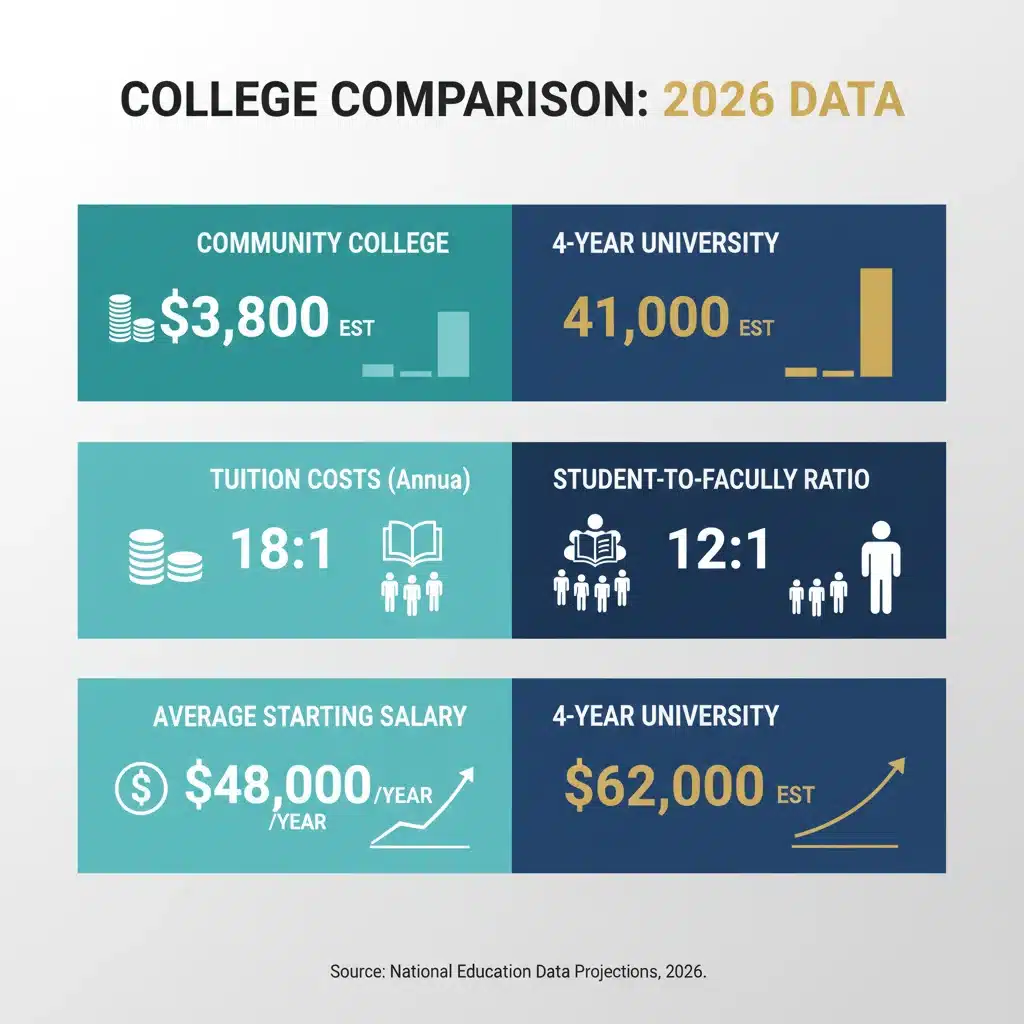
The most striking difference in a college cost analysis is typically tuition. Community colleges are renowned for their affordability. On average, in 2026, a year of tuition and fees at a public community college in the US is projected to be substantially lower than that of a 4-year public university. Private universities, of course, command even higher price tags. This significant difference can translate into tens of thousands of dollars saved over two years, providing a substantial financial advantage for students starting at a community college.
Anúncios
These lower tuition rates at community colleges are often due to a combination of factors, including state and local government funding, a focus on local community service, and generally fewer on-campus amenities compared to large universities. For students looking to complete general education requirements or earn an associate’s degree without accumulating massive debt, community colleges present an incredibly attractive option.
Living Expenses: On-Campus vs. Commuting
Beyond tuition, living expenses form a substantial part of the total cost of higher education. Many 4-year universities, especially those with residential campuses, require first-year students to live in dormitories. While this offers a rich social experience, it comes with considerable costs for room and board. These expenses can often rival or even exceed tuition costs, adding significantly to the overall burden.
Community college students, on the other hand, typically live at home and commute to campus. This allows them to save significantly on room and board, food plans, and associated living expenses. While commuting introduces its own costs (transportation, gas, parking), these are often far less than the cost of living on a university campus. This aspect of the college cost analysis often tips the scales for students from lower-income backgrounds or those who prefer to remain close to their families and support networks.
Financial Aid and Scholarships: A Complex Web
Both community colleges and 4-year universities offer financial aid, but the types and amounts can vary. Students attending either institution are eligible for federal financial aid programs, such as Pell Grants, federal student loans, and work-study programs. However, the availability of institutional scholarships can differ. Larger 4-year universities, especially private ones, often have extensive endowments and a wider array of merit-based and need-based scholarships that can significantly reduce the net cost of attendance.
Community colleges also offer scholarships, often from local foundations, private donors, and state programs specifically designed to support local students. While these might be smaller in individual value compared to some university scholarships, when combined with lower tuition, they can make community college virtually free for many eligible students. A thorough college cost analysis must factor in potential financial aid packages from both types of institutions to determine the true out-of-pocket expenses.
Student Loan Debt: A Long-Term Consideration
One of the most pressing concerns for students and families is student loan debt. The average student loan debt for a bachelor’s degree graduate in the US is substantial and can impact financial freedom for years. By starting at a community college, students can significantly reduce the amount they need to borrow. Completing the first two years at a community college and then transferring to a 4-year university for the final two years (the “2+2 model”) is a highly effective strategy to minimize debt.
This approach allows students to earn the same bachelor’s degree but with potentially tens of thousands of dollars less in student loan obligations. This long-term financial benefit is a critical component of any comprehensive college cost analysis and should not be overlooked.
Academic Environment and Student Experience
Beyond finances, the academic environment and overall student experience play a crucial role in a student’s success and satisfaction. Community colleges and 4-year universities offer distinct educational settings, each with its own advantages.
Class Size and Faculty Interaction
Community colleges are often characterized by smaller class sizes compared to large introductory courses at many 4-year universities. This can lead to more personalized attention from instructors, increased opportunities for student-faculty interaction, and a more supportive learning environment. Professors at community colleges often prioritize teaching over research, which can translate into more dedicated classroom instruction and accessibility for students.
Conversely, while large universities may have some smaller upper-division courses, initial years often involve large lecture halls, especially for general education requirements. While this can foster a sense of anonymity that some students prefer, it can also make it challenging to engage with professors or receive individualized help. The choice here often depends on a student’s preferred learning style and comfort level in different academic settings.
Diversity of Programs and Specializations
4-year universities typically offer a broader range of academic programs, majors, and specialized fields of study. Students with very specific or niche academic interests might find more tailored programs at a larger university. They also often have more extensive research facilities, laboratories, and libraries, which can be invaluable for certain fields of study.
Community colleges, while offering a solid foundation in general education and popular associate degree programs, may have a more limited selection of specialized courses. However, they excel in providing vocational and technical training programs that lead directly to employment in high-demand fields, such as nursing, automotive technology, culinary arts, and information technology. For students seeking direct career pathways or exploring different interests before committing to a major, community colleges offer practical and efficient options.
Campus Life and Extracurricular Activities
The “college experience” often conjures images of vibrant campus life, sports events, clubs, and dorm life. 4-year universities, particularly residential ones, typically offer a rich array of extracurricular activities, social events, athletic programs, and student organizations. This can be a significant draw for students looking for a comprehensive social and developmental experience alongside their academics.
Community colleges, while increasingly offering student clubs and activities, generally have a less extensive campus life due to their commuter-heavy student body. However, many community colleges are actively working to build a stronger sense of community through student government, clubs, and events. For students who prioritize academics and affordability, or who have family and work commitments, the more focused environment of a community college can be ideal. It’s important for students to assess what kind of campus experience is most important to them when conducting their personal college cost analysis.
Transfer Pathways and Career Outcomes
The ultimate goal of higher education for many is career advancement and personal growth. Both community colleges and 4-year universities can lead to successful outcomes, but the paths and immediate opportunities may differ.
Seamless Transfer: The 2+2 Model
One of the most significant advantages of community colleges is their robust transfer pathways to 4-year universities. The “2+2 model,” where students complete their first two years (associate’s degree or general education requirements) at a community college and then transfer to a 4-year university to complete their bachelor’s degree, is a well-established and increasingly popular route. Many states have articulation agreements between community colleges and public universities, guaranteeing admission or transfer of credits for students who meet specific criteria.
This model allows students to save a substantial amount of money on their first two years of education while still earning a degree from their desired university. It also provides an opportunity for students to mature academically, solidify their major choice, and gain confidence in a more supportive environment before transitioning to a larger university setting. When performing a college cost analysis, the 2+2 model often emerges as the most financially prudent option for obtaining a bachelor’s degree.
Direct Career Entry vs. Advanced Degrees
Community colleges excel at preparing students for direct entry into the workforce. Their vocational and technical programs are often designed in collaboration with local industries to ensure graduates possess in-demand skills. Many associate degrees lead to well-paying jobs in fields like healthcare (nursing, medical assisting), skilled trades (electrician, HVAC), and technology (IT support, web development). For students who want to enter the job market quickly and efficiently, community colleges provide an excellent pathway.
4-year universities, particularly those with strong research programs, often prepare students for roles that may require a bachelor’s degree as a minimum entry point or serve as a foundation for graduate and professional studies (e.g., law school, medical school, Ph.D. programs). While a bachelor’s degree can open doors to a wider range of career paths and often leads to higher lifetime earnings, the immediate return on investment can sometimes be slower due to the longer duration of study and higher initial cost. A comprehensive college cost analysis should consider both immediate and long-term earning potential.
Networking Opportunities
Both types of institutions offer networking opportunities, albeit in different forms. Universities often have extensive alumni networks that can be valuable for career advancement and mentorship. Career services departments at universities also tend to have strong connections with larger national and international employers.
Community colleges, on the other hand, often have strong ties to local businesses and industries. Their career services might focus more on local job placement and internships, which can be incredibly beneficial for students looking to work within their community. The networking opportunities at community colleges are often more direct and localized, which can be a significant advantage for certain career paths.

Making the Right Choice: A Personalized College Cost Analysis
The decision between a community college and a 4-year university is deeply personal, with no one-size-fits-all answer. Your ideal path will depend on your individual circumstances, academic goals, financial situation, and career aspirations. To make the best choice in 2026, consider the following:
- Assess Your Financial Situation: Be brutally honest about what you and your family can afford. Use net price calculators available on college websites and conduct a thorough college cost analysis that includes tuition, fees, books, living expenses, and potential financial aid. How much debt are you comfortable taking on?
- Consider Your Academic Preparedness and Preferences: Are you ready for the rigors of a large university, or would you benefit from a smaller, more supportive learning environment? Do you have a clear major in mind, or do you need time to explore?
- Define Your Career Goals: Do you need a bachelor’s degree for your desired profession, or will an associate’s degree or vocational certificate suffice? Are you looking for immediate entry into the workforce or planning for graduate studies?
- Research Transfer Agreements: If you’re considering community college, thoroughly research articulation agreements with 4-year universities in your state or desired institutions. Ensure your credits will transfer seamlessly.
- Explore Campus Culture: While a college cost analysis is crucial, don’t forget the importance of fit. Visit campuses, talk to current students, and consider the kind of social and academic environment where you will thrive.
Hybrid Approaches and Flexibility
It’s also important to remember that the path to higher education doesn’t have to be linear. Many students combine elements of both. For example, some might start at a community college, transfer to a 4-year university, and then pursue a master’s degree. Others might take a gap year, work, and then enroll in a community college part-time while continuing to work. The flexibility offered by both systems allows for diverse educational journeys.
Conclusion: Empowering Your Higher Education Decision
As US students look towards their higher education options in 2026, the choice between a community college and a 4-year university remains one of the most significant decisions they will make. While 4-year universities offer prestige, extensive programs, and a vibrant campus life, community colleges provide an incredibly valuable, cost-effective, and flexible entry point into higher education, often leading to the same bachelor’s degree at a fraction of the cost.
By conducting a thorough college cost analysis, evaluating academic preferences, and understanding career goals, students can confidently choose the path that best suits their individual needs. Whether you opt for the immediate immersion of a university campus or the strategic, debt-reducing approach of starting at a community college, both pathways offer immense opportunities for learning, growth, and future success. The key is to be informed, thoughtful, and proactive in shaping your educational journey. Your future begins with an informed decision today.